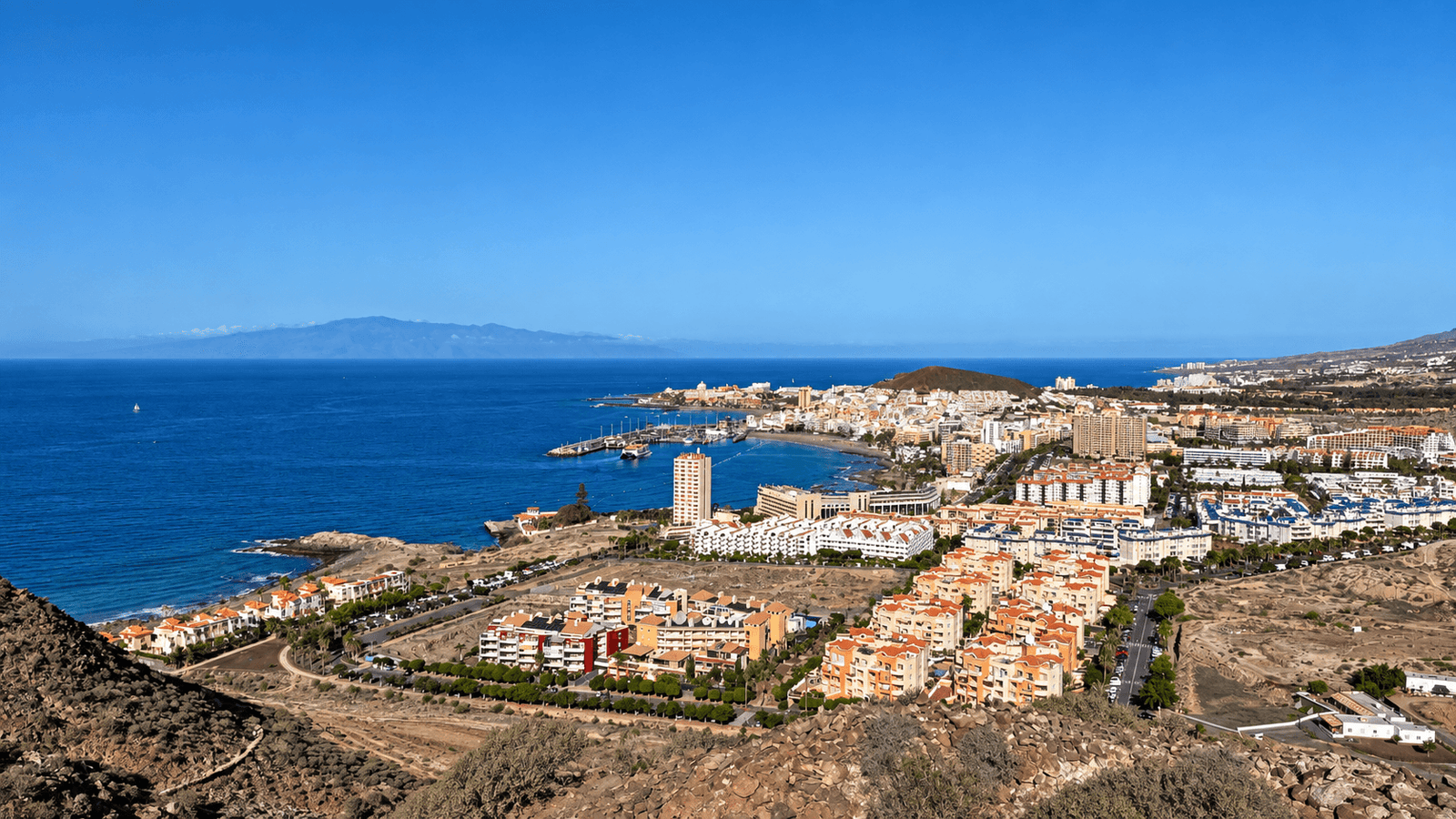
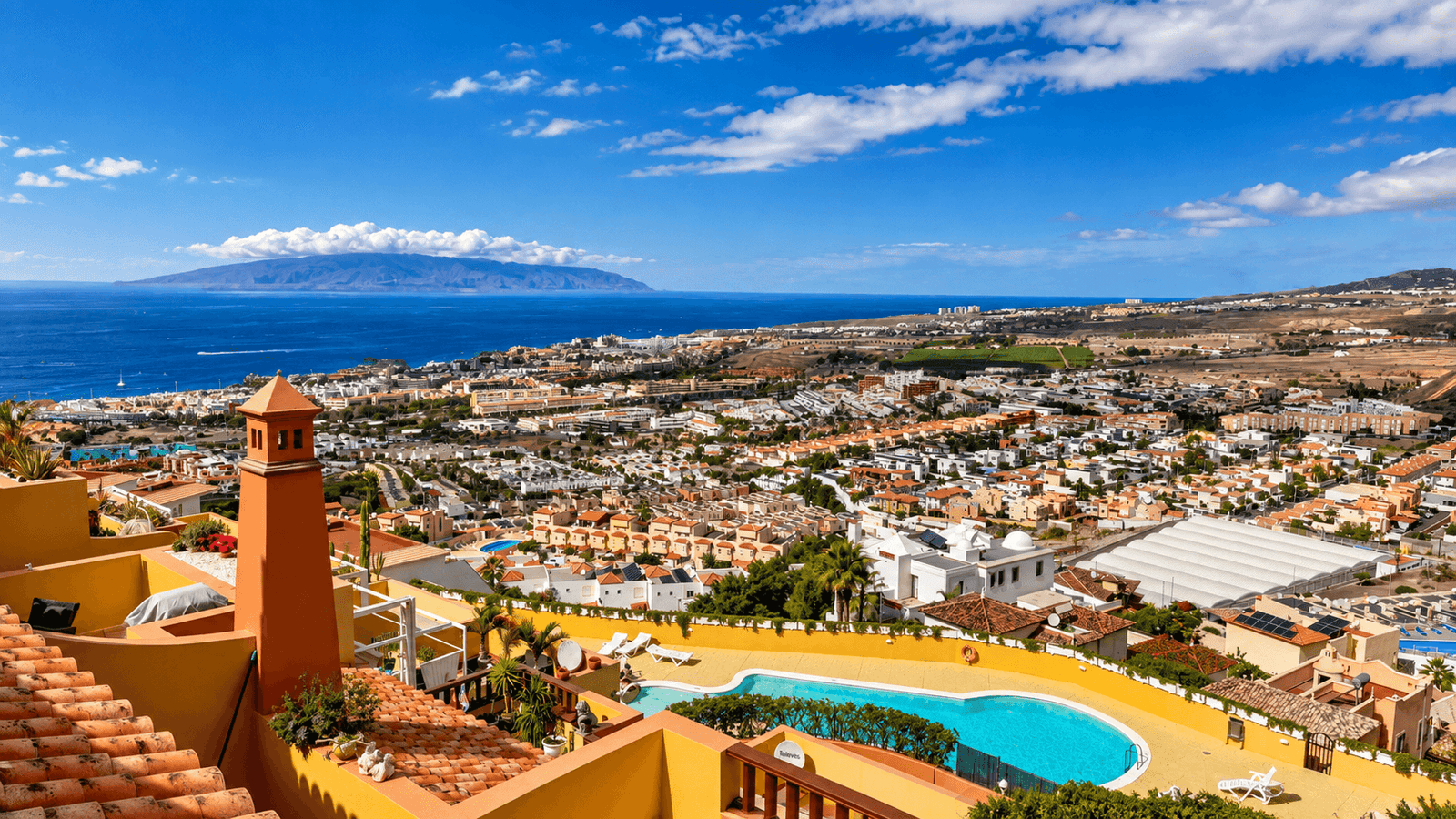
This Costa Adeje area guide explains how the area is laid out, how its different parts compare and what daily life is like. It is written for people considering living, buying or spending longer periods here.
Costa Adeje is not one uniform place, so the focus is on the differences between its districts and what those differences mean in practice.
Costa Adeje at a Glance
- Location: South-west Tenerife
- Municipality: Adeje
- Character: Coastal, international and varied
- Main appeal: Beaches, restaurants, amenities and year-round activity
- Getting around: Easy on foot in lower areas; a car is more useful higher up
- Often chosen by: Full-time residents, second-home owners and people wanting an established coastal area
Where Is Costa Adeje?
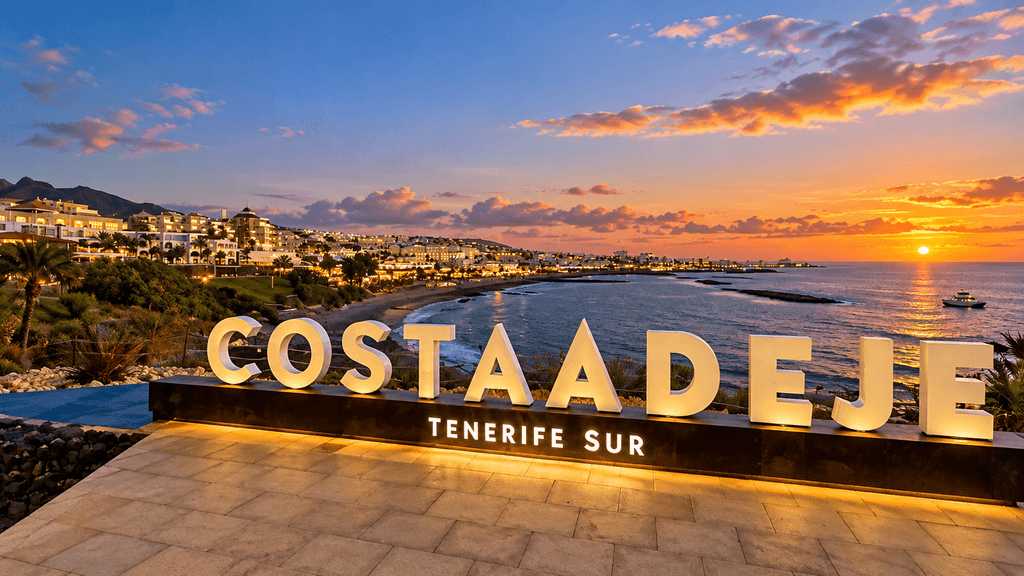
Costa Adeje sits on the southern coast of Tenerife, in the main resort belt of the island’s south-west. It belongs to the municipality of Adeje, which runs from the shoreline up into the mountains and also includes Adeje town.
The two are quite different. The town sits inland and higher up, with a historic core and a slower, more local feel. Costa Adeje is the resort and residential coast below it. The name “Adeje” is sometimes used for both, so it is worth checking which one a listing or conversation means.
Heading south-east, Costa Adeje runs into Playa de las Américas, and there is no sharp dividing line in everyday use. Beyond that is Los Cristianos, an older harbour town in neighbouring Arona (our Los Cristianos area guide covers it in more detail).
Tenerife South Airport is on the same side of the island and reached mainly by the TF-1 motorway. Journey times depend on traffic and on where exactly you are based.
Costa Adeje Covers More Than One Area
“Costa Adeje” is used in more than one way. In everyday local conversation it usually points to the resort coast, but in property searches it is often a much broader label that groups together many different districts within Adeje municipality.
Buyers often assume the name refers only to the strip around Playa del Duque, Fañabé and La Caleta. Depending on the portal or the agency, a search for Costa Adeje can also return listings in places such as Fañabé Alto, El Madroñal, San Eugenio Bajo, San Eugenio Alto, Torviscas Bajo and Alto (including Roque del Conde), Callao Salvaje, Playa Paraíso, Armeñime, Los Menores, Tijoco and Marazul. Some searches also include Adeje town and its casco urbano, along with other upper or inland locations in the surrounding areas.
These places can differ considerably. Two properties both labelled “Costa Adeje” may be a short walk from the sea and the promenade or higher up the hillside with more space and wider views but a greater need for a car. The gap between lower districts near the sea and upper residential ones is often the most significant. Access to shops, restaurants and public transport, the gradient of the streets, noise levels and the general feel of daily life can all vary, even when the listings appear side by side.
Portal classifications vary, and everyday local usage does not always match them. None of these names should be treated as precise administrative boundaries. The practical approach is to treat the label as a starting point, then check the exact location on a map, the distance to the beach and the shops, and which district the property really sits in.
Main Areas of Costa Adeje
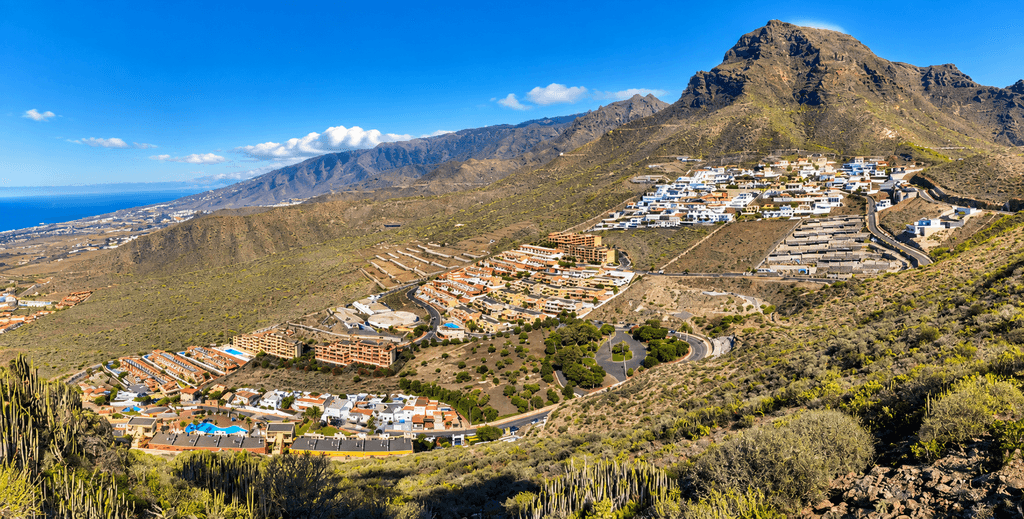
Local area names overlap, and residents do not always agree on where one ends and the next begins. Several of these districts also have a lower part and a higher residential part, and daily life in each can be quite different. Treat the table and descriptions below as a general guide. They run roughly from north-west to south-east.
| Area | General Character | Coast / Access | Typical Feel |
|---|---|---|---|
| La Caleta | Former fishing village, low-rise | Rocky waterfront, small bathing areas | Relaxed, more local |
| Playa del Duque | Hotel-led, with shops and restaurants close by | Broad beach, walkable seafront | Calmer, more upmarket |
| Fañabé | Mix of hotels, apartments and residential streets | Long beach, walkable seafront | Balanced |
| Torviscas | Busy and convenient lower down; more residential and elevated higher up | Lower part is close to the seafront; upper areas are more car-dependent | Apartments near the sea; hillside homes and villas around Roque del Conde |
| San Eugenio | Commercial and service-oriented, with a residential upper part | Lower part near the sea; upper part on higher ground | Busier, closer to Las Américas |
| Puerto Colón | Marina and waterfront | Marina beach and boat departures | Lively, tourism-led |
La Caleta
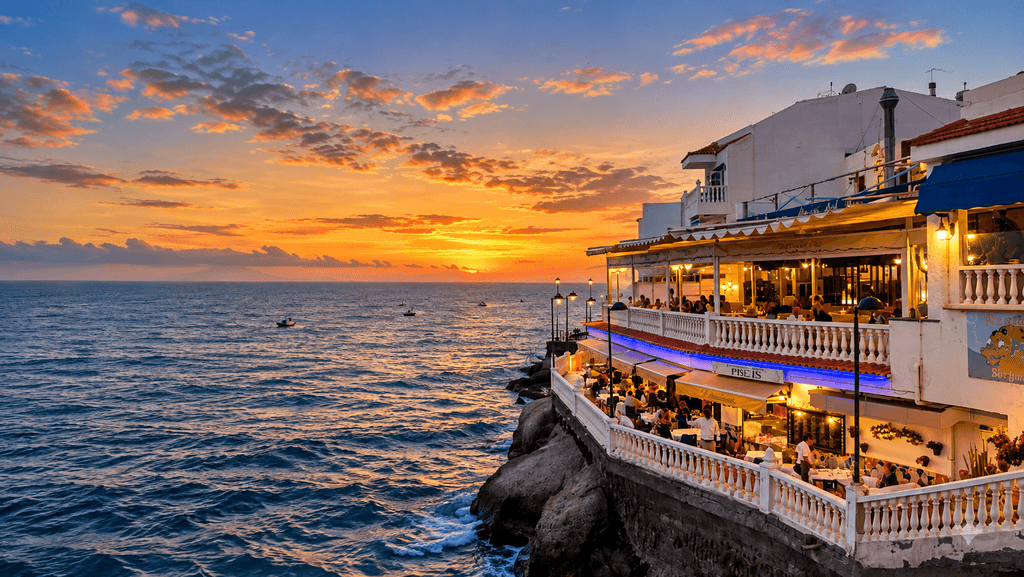
La Caleta began as a fishing village and still feels smaller in scale than the areas around it. It is quieter and lower-rise, with a rocky waterfront, small bathing areas and a strong reputation for fish and seafood restaurants. It is not a conventional sandy-beach resort.
Larger shops and services are a short distance away towards Plaza del Duque, and parking can be tight. It tends to appeal to people who prefer a calmer, more local atmosphere over a busier, more commercial feel.
Playa del Duque
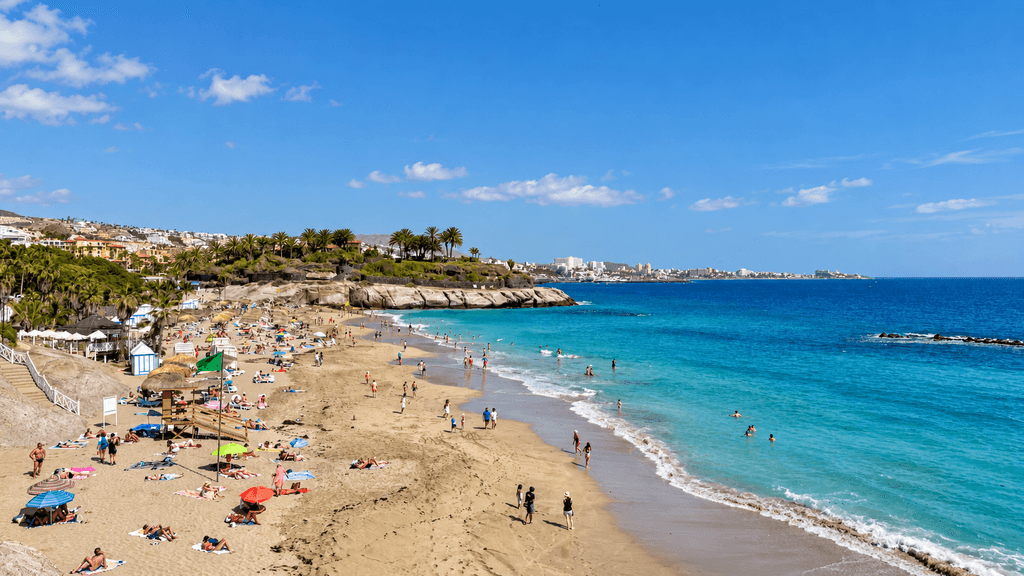
This is one of the most polished parts of the coast. It has a broad beach, a well-kept promenade and Plaza del Duque, where shops and restaurants sit close together.
Large hotels line the seafront, so it is not purely residential, but the mood is generally calmer and more upmarket than in the busier central parts. Buyers who put the seafront first often look here, although prime locations can carry higher prices.
Fañabé
This is a central part of Costa Adeje, with one of its longer beaches and a mix of hotels, apartment complexes and residential streets rising inland. Restaurants and bars are close by, but the feel is generally less intense than in the busier central stretches.
Families and residents who want beach access and everyday services within reach often find this a practical base. The upper part of the district has a different character, with more slopes, wider views and a greater need for a car.
Torviscas
This district changes noticeably as you move inland and uphill, so it is better understood as several distinct parts than as one uniform place. It sits towards the middle of the built-up coast and runs from the busy seafront up into calmer residential hillside.
Torviscas Bajo is the lower area, close to the seafront, beaches, restaurants, bars and everyday amenities. It tends to be busier and more commercial, and it is the more convenient part for people who want to walk to the sea.
Torviscas Alto is more elevated and residential, and many parts are quieter. The streets are steeper, and how much you rely on a car depends on the exact location. Many properties benefit from wider views.
Roque del Conde forms part of this upper area and is a sought-after residential setting on the hillside. It has a mix of apartments and larger villas, and some of the higher-position properties are more substantial. Many properties have wide ocean views, and from some higher, well-orientated positions the outlook can extend towards La Gomera, which is a major attraction for some buyers. Access is generally more car-dependent than in the lower area, and views vary with height and orientation, so they are worth checking in person.
People who want convenience and activity on the doorstep tend to look at the lower part, while those who prefer more space, elevation and views and are comfortable driving often look higher up. Our Torviscas area guide looks at this district in more detail.
San Eugenio
San Eugenio sits towards the Playa de las Américas end of Costa Adeje. It is commercial and service-orientated, with a shopping centre, restaurants and many apartment complexes, and it is closer to the nightlife of the neighbouring resort.
San Eugenio Alto, the upper part, is more residential and set on higher ground. Those who want a central position with easy access to both Costa Adeje and Las Américas often consider it. Our San Eugenio area guide covers it further.
Puerto Colón
This is the marina, and boat trips and whale-watching tours depart from here. Waterfront bars and restaurants keep it lively into the evening, and there is a beach beside the marina.
Apartments surround the marina, but tourism dominates. It tends to appeal to people who like activity around them and are less concerned about quiet.
Other Areas Often Grouped Under Costa Adeje
El Madroñal is another important residential area, set higher up the hillside, that often appears in broad Costa Adeje property searches. Places such as Callao Salvaje, Playa Paraíso, Armeñime, Los Menores and other upper or inland districts may appear too.
Each is a distinct area with its own character, and several may deserve a separate guide, so it is better to treat them as places in their own right rather than simple extensions of the main tourist area.
Costa Adeje Beaches and Seafront Promenade
The beaches here are largely urban, with sunbeds, showers and lifeguard services in the main areas. Facilities and sand tones vary from one beach to the next.
- Playa del Duque: a wide beach with restaurants directly behind it
- Playa de Fañabé: a longer beach, popular with families
- Torviscas beach: sits within one of the busier central stretches of the area and tends to have more activity around it
- Puerto Colón area: beaches beside the marina, generally more active, with water sports nearby
- La Caleta waterfront: rocky, with small bathing areas and a more local feel
A promenade links much of this coast, and long stretches can be walked at a relaxed pace, mostly on level ground. Many residents use it as part of a daily routine.
The beaches are easiest to reach from the lower districts. From higher areas, the sea is usually a drive or a longer, steeper walk.
Restaurants, Shopping and Everyday Amenities
Daily needs are well covered in most lower parts of Costa Adeje, and the variety changes noticeably from one district to the next.
Eating Out
Cafés and restaurants line the seafront and the streets behind it. Higher-end dining is particularly noticeable around Playa del Duque and La Caleta, while the wider area has a broad mix of casual, international and Canarian options. La Caleta is especially known for fish and seafood.
Prices and quality vary, so local knowledge helps. Streets set back from the seafront are often more useful for everyday meals.
Shopping and Everyday Services
For shopping in Costa Adeje, Plaza del Duque has a more upmarket mix of shops and restaurants. X-Sur (former Gran Sur) is a large shopping centre in the central part of Costa Adeje, with a supermarket, cinema and shops, and San Eugenio has its own shopping centre.
Supermarkets, pharmacies, banks, health clinics and other services are close to most of the lower areas. In some upper residential areas, everyday shops and services may be less convenient on foot, so a car can become more useful depending on the exact location.
Lifestyle and Living in Costa Adeje
Day-to-day life in the lower areas often centres on the coast: a morning walk on the promenade, a coffee, and an afternoon at the beach. Convenience is one of the main strengths, since many residents can reach shops, services and restaurants without a long journey.
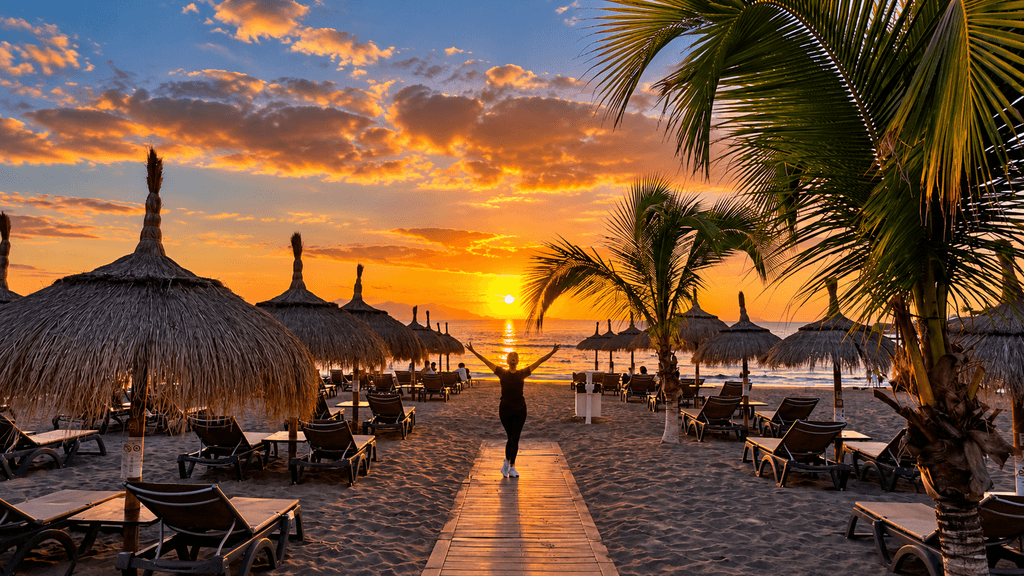
The population is a mix of full-time residents, second-home owners and visitors, and the balance changes by district and by season. Busier periods bring more people and traffic, particularly in commercial parts, while residential streets are generally more relaxed.
The trade-off is that the most convenient positions are often the busiest. The calmer streets and wider views are usually higher up, which means slopes and more driving. Visiting at different times of day and in different months gives a more honest picture than a single trip.
What changes from one part of Costa Adeje to another?
- Noise: higher near bars, restaurants and the marina, lower in residential streets
- Walkability: easy in lower areas, much harder on steeper upper streets
- Slopes: more noticeable in upper districts
- Parking: often limited near the seafront and in busy central areas
- Sea access: a short walk in lower areas, a drive or a longer climb from higher ground
- Views: generally wider from higher ground, depending on orientation
- Proximity to shops and restaurants: closest in central lower areas
Is Costa Adeje Good for Families?
Many families find it practical. The beaches are accessible, the lower areas are walkable, and parks, activities and everyday services are close at hand. Parts of the central area and the main beach districts are often associated with a family-focused atmosphere, though this depends on the specific street or complex. Upper districts are less walkable, so a car usually becomes part of family routines there.
Schools exist in and around the area, so it is worth checking individual schools, admission rules and language of instruction.
Getting Around Costa Adeje
Walking
The lower areas nearest the sea, down to the marina, are easy to walk. The promenade makes short trips to the beach and shops straightforward.
Upper districts such as Roque del Conde and El Madroñal involve slopes and longer, steeper walks to the seafront. Daily life there is generally more car-dependent.
Public Transport and Taxis
TITSA operates the island’s bus network, with services along the coast and to other parts of Tenerife. Check current routes and timetables for your address, as coverage varies by district and is usually better in lower areas. Taxis are widely available in the main areas.
Driving and Parking
Whether a car is useful depends on where you live. In many lower areas, day-to-day life can be manageable without a car, while in upper districts and hillside pockets a car is generally more useful.
Parking can be limited near the seafront and in busy central areas, so it is worth confirming whether a property comes with a space.
Things to Do in Costa Adeje
- Beaches and seafront walks
- The waterfront and marina
- Boat trips and whale watching
- Siam Park, on the edge of the area
- Barranco del Infierno, a walking route above the town of Adeje that needs booking in advance
- Wider Tenerife day trips, such as Teide, which is well outside Costa Adeje itself
Costa Adeje Climate and Year-Round Living
South Tenerife generally has a mild, warm climate, and it is usually sunnier and drier than the north of the island. That supports an outdoor lifestyle for most of the year, with terraces, beaches and walking part of everyday life.
The seasons still differ. Winters are milder than in much of Europe but not identical to summer, and evenings can feel cooler. Microclimates also matter: the lower area near the sea can differ from higher ground, and some spots are windier or cloudier than others.
Costa Adeje vs Playa de las Américas
The two areas run into each other, but their character differs.
| Feature | Costa Adeje | Playa de las Américas |
|---|---|---|
| Overall feel | More spread out, with polished and calmer parts | Denser and more concentrated |
| Nightlife | Present in the busier central areas and around the marina, less prominent elsewhere | A key part of its identity |
| Beach access | Long promenade linking several beaches; upper districts are further from the sea | Beaches close to the main resort streets |
| Residential areas | Mix of seafront and upper residential districts | Residential pockets among tourist areas |
| Restaurants | Range from casual to higher-end | Wide choice, often concentrated on busy streets |
| Who it may suit | Those wanting a calmer, more varied setting | Those wanting to be close to the nightlife |
The choice often comes down to how much energy and noise you want nearby. Neither is objectively better, and individual streets and complexes usually matter more than the name of the area.
Is Costa Adeje Expensive?
Some parts are among the more premium areas in south Tenerife, but costs vary significantly by location. Beachfront and newer complexes can command more, while larger villas with wide views in some upper districts can also sit at the higher end. Location within each area matters as much as the area name.
Everyday living costs depend heavily on lifestyle. Eating on the seafront costs more than choosing local places away from it, and community fees, utilities and property type all affect the total. Comparing specific properties and streets is more useful than relying on broad claims about the whole area.
Buying Property in Costa Adeje
Buyers here include second-home owners, full-time residents and people planning a mix of both. Apartments are common in the lower areas near the sea, while villas and larger homes are more often found in upper residential districts, including areas such as Roque del Conde and El Madroñal.
The trade-off is usually proximity to the sea against views, space and access. Lower locations offer convenience and easier walking. Upper locations often offer more space and wider outlooks but rely more on a car. A home used all year also needs to work in the quieter months, not just at the busiest times.
Practical points to compare:
- Seafront versus upper location
- Walkability
- Slopes
- Parking
- Community fees
- Views and orientation
- Distance to amenities
- Intended use of the property
Before buying, check community fees, licences, legal status and ongoing costs, and take independent legal advice. Any rental or holiday-letting plans should be checked for the specific property and against the rules in force at the time.
Our buying page explains the general process, and you can browse current options on our Properties for Sale in Tenerife page. Different parts of Costa Adeje suit different buyers, which is why location often matters as much as the property itself.
Is Costa Adeje the Right Area for You?
Costa Adeje may appeal if you value:
- Established infrastructure and everyday services
- Beaches and a seafront promenade
- A wide choice of cafés and restaurants
- Walkability in the lower areas
- A choice between livelier lower districts and calmer, higher residential ones
Things to consider:
- Busier tourist areas, particularly in commercial parts
- Traffic at peak times
- Limited parking near the seafront
- Hills and slopes in upper areas, with more reliance on a car
- Premium pricing in some locations
Explore Costa Adeje with the Tenerife Property Gallery
Tenerife Property Gallery can help buyers compare the different parts of Costa Adeje and understand the practical differences between lower areas near the sea and upper districts, as well as property types and ownership considerations. If you would like help narrowing down which part suits you, please get in touch through our contact page.