
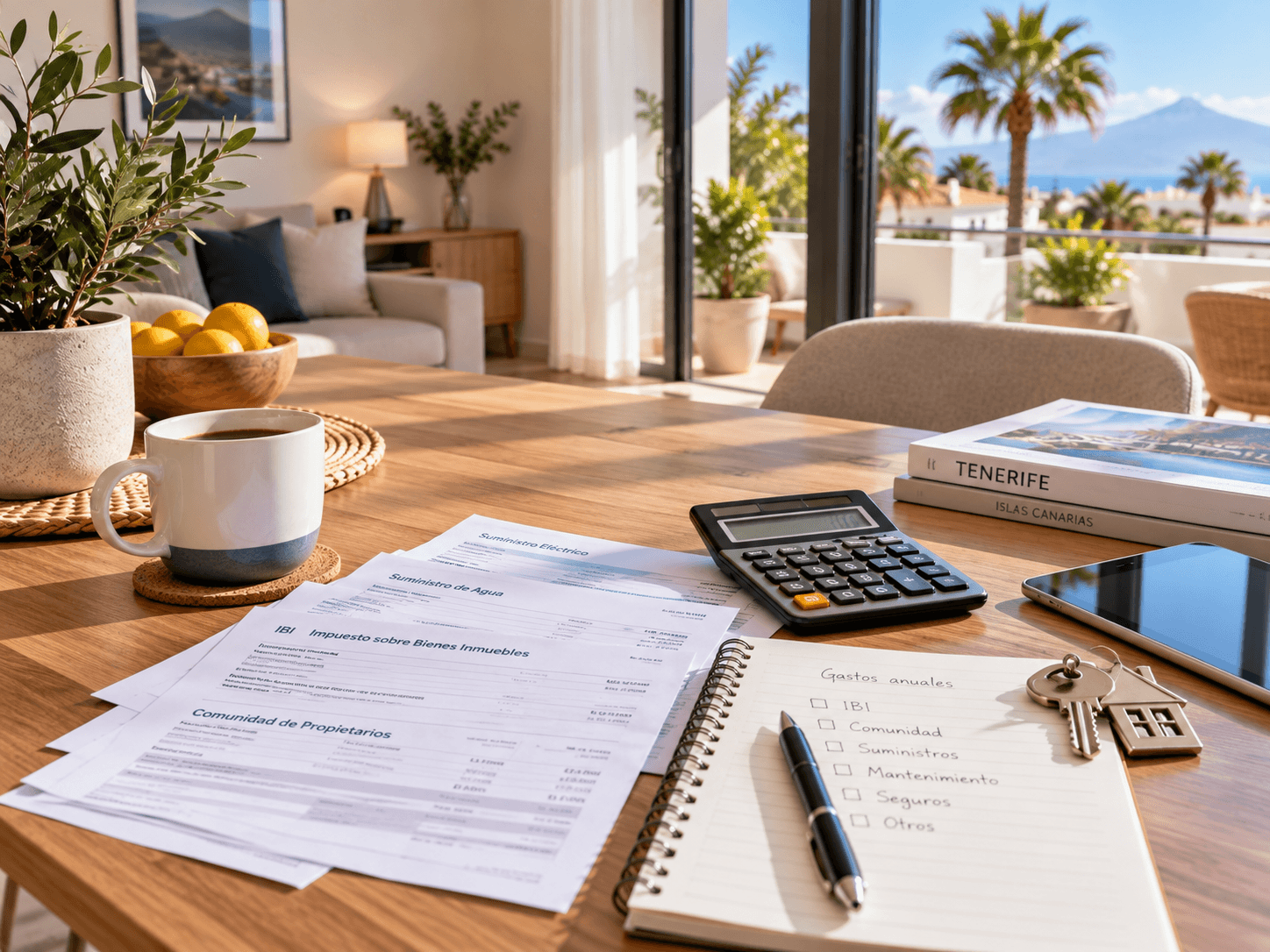
Buying a home in Tenerife is often seen as the big financial milestone, but the purchase price is only one part of the picture. Once the keys are in your hands, the cost of owning property in Tenerife includes a range of recurring expenses such as local taxes, community fees, utilities, insurance, maintenance and, for some buyers, additional tax obligations that continue whether or not the property is occupied.
Understanding these real costs in advance helps with the need to budget realistically and helps you avoid surprises further down the line. This guide sets out the main categories of expense, some billed annually and others monthly, that make up the ongoing costs of owning a home in Tenerife.
What Are the Main Costs of Owning Property in Tenerife?
Owning a home in Tenerife generally involves several recurring categories of expense, including:
- The local council tax (IBI)
- Additional tax obligations for owners living outside Spain, where applicable
- Community fees, if the property forms part of a managed complex
- Electricity, water and other utility bills
- Waste collection and other local charges
- Insurance for the building and its contents
- Maintenance and occasional repairs
- Key holding, property checks and management services
- Rental-related costs, if the property is let
There is no single reliable “average annual cost” that applies to every home on the island. The real figure depends on factors specific to your own property, such as its type and size, the municipality it sits in, the facilities of the community it belongs to, tax residence, whether it’s rented out, whether there’s a private pool or garden, and how often it’s used. A small apartment in a modest complex and a detached villa will have very different cost profiles, so treat any generic figure you see quoted elsewhere with some caution.
1. IBI Property Tax
IBI (Impuesto sobre Bienes Inmuebles) is the local annual tax charged by the town hall (ayuntamiento) in the municipality where the property is located. It applies to virtually all owners in Spain, whatever their residency status.
The amount payable is based on the property’s cadastral value and the tax rate set by the relevant municipality. Because both the cadastral value and the rate vary from one town hall to the next, and from one property to another, bills can differ noticeably even between similar homes on the island. Check the specific rate and cadastral value that apply to your own property, typically shown on the annual receipt or available from the relevant town hall.
2. Non-Resident Property Tax
Non-resident owners may have Spanish tax obligations connected to the property, even if it’s never rented out and is used purely as a holiday home. These obligations are separate from local council tax and are generally administered through the national tax authority rather than the town hall.
The tax treatment can differ depending on whether the property generates rental income or is kept solely for personal use, and individual circumstances, such as tax residence, nationality and how the property is used, can affect what is owed. Because rules in this area can change and depend on personal circumstances, this guide doesn’t attempt to state specific percentages. It is strongly advisable to confirm your position with an accountant or tax adviser familiar with Spanish tax rules for owners based abroad, ideally before completing a purchase, and to review it regularly thereafter.

3. Community Fees
Many apartments, and some villas within managed developments, form part of a comunidad de propietarios (community of owners). This community is typically responsible for maintaining shared areas and services, and each owner contributes through regular community fees.
Depending on the development, these fees may cover items such as lift maintenance, communal pools, gardens and landscaping, cleaning of shared areas, security, communal lighting, and insurance for shared structures. Community fees vary significantly from one development to another, reflecting the facilities on offer and the size of the complex; a building with lifts, gardens and security will generally have higher running costs than a small block with minimal shared services.
It’s also worth knowing that communities can occasionally raise extraordinary assessments, known as derramas, to cover unplanned or significant works, such as roof or lift replacement, or upgrades to shared infrastructure. Prospective buyers are encouraged to review the community’s budget, fee history and any planned works before buying so they have a realistic sense of what they’re likely to pay each year.
4. Electricity, Water and Utility Costs
Bills for power and water form a regular part of ownership and depend heavily on how the property is used. Electricity is typically billed with a standing charge based on contracted power, plus a variable charge for what the meter shows each period; water usually works in a similar way, with a fixed and a consumption-based element.
Owners who live in the property full-time will naturally use more than those who visit only occasionally, and features such as a private pool, air conditioning, electric heating or a large garden needing irrigation can push consumption up noticeably. Internet and telecoms, where an owner chooses to maintain a connection year-round, add a further monthly cost. Rather than relying on generic “average” utility figures, which can be misleading given how much usage varies, it’s more useful to review your own bills from the property, where available, or ask the seller or managing agent for recent statements.
5. Rubbish Collection and Other Local Charges
In addition to the local council tax, some municipalities apply separate charges, which may include a waste collection fee (tasa de basura). How this is billed differs depending on the area and, in some cases, the type of property; it may appear as its own annual invoice, be folded into another municipal charge, or be handled differently again elsewhere.
Because arrangements are set at the municipal level, it’s not accurate to assume the same system applies uniformly across every town in Tenerife. Check directly with the relevant town hall, or with your property manager or adviser, to understand exactly what local charges apply and how they’re billed for your particular home.
6. Home and Buildings Insurance
Insurance is an important, and sometimes overlooked, part of ownership. A policy on the structure of the property is usually separate from cover for furniture, appliances and personal belongings inside it. It is worth confirming exactly what each policy includes.
Where a property sits within a community, the community’s own policy may cover the building’s common elements, but this doesn’t necessarily extend to the inside of an individual apartment or to personal contents. It’s worth reviewing what any communal policy actually covers, rather than assuming it’s comprehensive. Owners with a mortgage should also check any insurance requirements imposed by their lender. Even those without a mortgage are generally well advised to maintain adequate insurance, given the cost of rebuilding or restoring a home in the event of damage.
7. Maintenance and Repairs
Routine upkeep is a recurring, if sometimes unpredictable, part of ownership. This can include servicing air-conditioning units and appliances, plumbing and electrical work, upkeep of terraces and outdoor spaces, garden care, and, for homes with a private pool, regular cleaning and chemical treatment.
Tenerife’s climate and, in some areas, proximity to the coast can accelerate wear on exteriors, metalwork and outdoor furnishings, meaning repainting and general upkeep may be needed more often than in some other locations. Alongside routine care, it’s sensible to set aside a contingency for unexpected costs, such as a failed water heater or a leak, rather than assuming expenses in this area will always be predictable from one year to the next.
8. Property Management, Key Holding and Property Check-Ups
For those who don’t live in Tenerife full-time, practical support can be genuinely useful in keeping a home in good condition between visits. This commonly includes key holding, so someone is available to grant access when needed; periodic checks, to catch small issues before they grow; coordination of tradespeople for repairs or servicing; and emergency access arrangements in case something goes wrong while you’re away.
The right level of support depends on how often you visit, whether the property is let, and personal preference. Some owners prefer occasional check-ins, while others want closer oversight of maintenance and upkeep. Either way, these services add a further monthly or annual cost worth including alongside the other categories covered here.
9. Rental-Related Costs If You Let the Property
Owners who choose to let their property, whether long-term or as a holiday rental, should budget for a further set of costs on top of standard ownership expenses. These can include management fees if using a letting agent, cleaning between stays, extra wear and tear, accounting or tax-related costs linked to declaring rental income, and utilities where these aren’t passed on to tenants.
It’s also worth checking whether the community has any restrictions or requirements relating to rentals, as rules can vary between developments. Requirements and eligibility for holiday rentals can also change over time and depend on the specific property and municipality, so anyone considering this route should seek current, property-specific guidance rather than relying on general assumptions.
How Much Should You Budget Each Year?
Given everything above, the honest answer is that the right budget depends on the individual property and each property owner’s specific circumstances. Rather than looking for a single Tenerife-wide figure, it’s more useful to build a picture from your actual costs: the local council tax, community fees, power and water costs, insurance, maintenance, any applicable local charges, management or key-holding fees, and tax obligations relevant to your situation.
As a general pattern, a villa with a private pool and garden will typically carry a different, often higher, cost profile than an apartment within a well-managed complex, simply because it involves more individual upkeep and higher consumption. This doesn’t mean one is a poor choice and the other a good one; it simply means the real costs should be understood and budgeted for based on the specific property in question.
Checklist: Annual Property Costs to Plan For
- Local council tax, charged annually
- Tax obligations for owners based abroad, where applicable
- Community fees
- Electricity and water costs
- Waste collection and other local charges
- Insurance (building and contents)
- Maintenance and upkeep, plus a contingency
- Key holding and property check-ups
- Property management costs
- Rental-related costs, where applicable
Need Help Looking After a Property in Tenerife?
Owning a home on the island is a long-term commitment, and staying on top of the practical side makes a real difference, especially for those who spend part of the year elsewhere. Tenerife Property Gallery can help owners look after their own property, from key holding and property check-ups to coordinating maintenance and servicing, and can put you in touch with appropriate independent professionals for specialist tax or legal advice where this is needed.
If you’d like support with your property, visit our Property Services page or get in touch through our Contact page. Prospective buyers may also find our Buying guide useful for understanding the full picture of owning a home in Tenerife.